Han dynasty
The Romance of the Three KingdomsThe Han dynasty is both the political order whose breakdown sets the novel in motion and the standard against which its competing rulers justify their power. Its collapse unfolds through court capture, famine, and warlord conflict, then becomes a contest over whether dynastic legitimacy rests on hereditary lineage, effective rule, or the Mandate of Heaven. The abdication to Cao Pi ends Han sovereignty, but not the political struggle over who may claim its inheritance.
Identity and Historical Setting
The novel places its story in the disintegration of the Han dynasty, roughly from AD 168 to 280, although it was written about a thousand years after the events it recounts. Its author builds on a historical record compiled near the end of the third century, while shaping that record through oral storytelling and drama into an epic of heroes, betrayers, and rulers. The dynasty’s fall is thus presented as history retold through political and moral conflict, not merely as a sequence of battles.
The Han had ruled China for more than four hundred years, interrupted by Wang Mang’s seizure of power from AD 9 to 25. In the novel’s account, it stands as a durable and exemplary dynasty: unlike earlier periods partly obscured by myth and legend, Han history is represented as extensively recorded. That long record and remembered stability make its eventual collapse especially consequential. The fall is not only the removal of one ruling house; it becomes a warning about ambition, abuse, court intrigue, and the fragility of political order.
From Court Crisis to Imperial Fragmentation
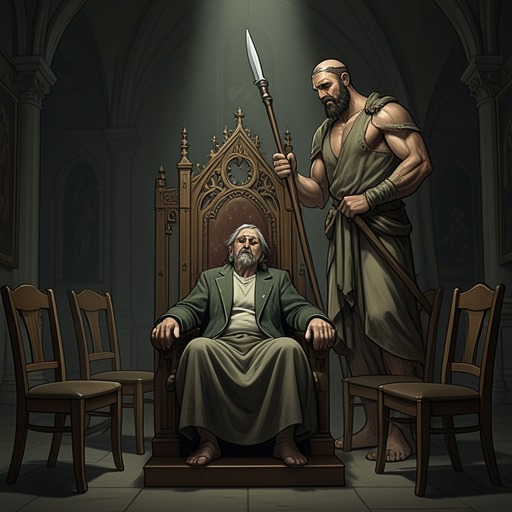
The narrative traces the final crisis to the conduct of earlier emperors and the growing power of court factions. Emperor Huan favored eunuchs over ministers of integrity. Emperor Ling failed to sustain a palace conspiracy against them, and its instigators were executed. The eunuchs then gained control while the emperor withdrew into the palace. The Ten Imperial Attendants, led by Zhang Rang, came to dominate the court as unrest spread across the empire.
The breakdown of central authority develops into a wider contest among armed leaders. The historical sequence recalled by the book repeatedly moves from division to reunification and back again: the Zhou empire had fractured among seven kingdoms before Qin conquered them; Chu and Han then fought until Han prevailed; and, after a later uprising, Emperor Guang Wu restored unity. Under Emperor Xian, the empire again splits. Three leaders emerge from the disorder—Liu Bei, referred to in the book as Xuande, Cao Cao, and Sun Quan—each ultimately founding a dynasty and carving out a kingdom from the weakening Han realm.
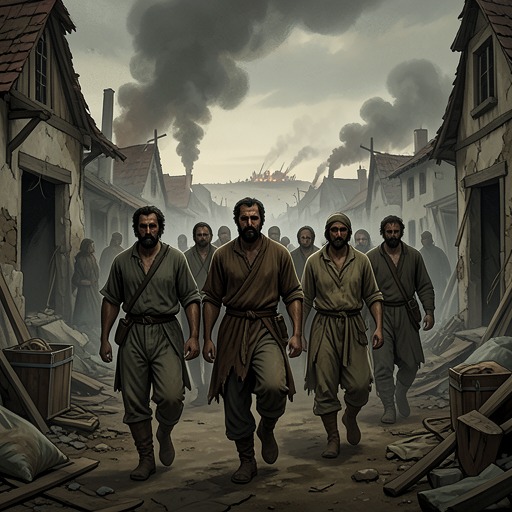
The human consequences of the collapse are measured not only in political losses. In one account of the ruined capital, only a few hundred families remain in Luoyang, and famine leaves them surviving on bark and roots; people die beside the remains of their homes. The novel’s broad history of ambition and succession is therefore joined to the material consequences of state failure: the inability to secure food and order reaches ordinary households as surely as it reaches the palace.
Competing Claims to Han Legitimacy
The Han’s authority remains a political resource even as its ability to govern contracts. Cao Cao controls the emperor and, with him, gains the allegiance of many nobles. Kong Ming explains that this imperial connection makes Cao Cao difficult to oppose, despite the latter’s rise by cunning. The emperor himself sees the difference between nominal protection and actual control: after Dong Zhuo’s tyranny and the revolt of Li Jue and Guo Si, Cao Cao appears to defend imperial honor while appropriating the power behind it.
Other claimants invoke the same crisis to support their own ambitions. Yuan Shu possesses the Imperial Seal and declares that the Mandate has left the Han for his clan. He cites oracles and Five Elements sayings as confirmation, then performs imperial rites and establishes a court. The episode contrasts possession of an emblem and ritual assertion with the broader question of legitimate rule: the dynasty’s decline allows the language of Heaven’s mandate to be used not only to defend the Han but also to challenge it.
Xuande’s claim rests on descent from the Han imperial line and on continued allegiance to the dynasty. After Cao Cao’s rise, the emperor recognizes Xuande’s imperial lineage, gives him the title of imperial uncle, and takes him into his confidence. Later, when Xuande’s commanders urge him to become emperor, Kong Ming argues that Cao Cao has usurped the true ruler and that Xuande’s reputation for benevolence and control of Shu make the moment appropriate. Xuande writes to the emperor, recounting the repeated abuses of imperial authority, the failed conspiracy with Dong Cheng, and the danger that Cao Cao’s growing power poses to the throne. His argument presents resistance as service to the Han, even as it brings him toward claiming the imperial title himself.
Abdication and the End of Han Rule
In AD 220, court astrologers and officials interpret the appearance of a phoenix, a unicorn, and a yellow dragon as signs that Han authority has ended and that the Mandate is passing to Wei. They request a formal abdication. The Han emperor initially responds with grief, remembering the founder of the dynasty and its four centuries of succession through the Liu family, and asking what wrong he has committed to be made to surrender his inheritance.
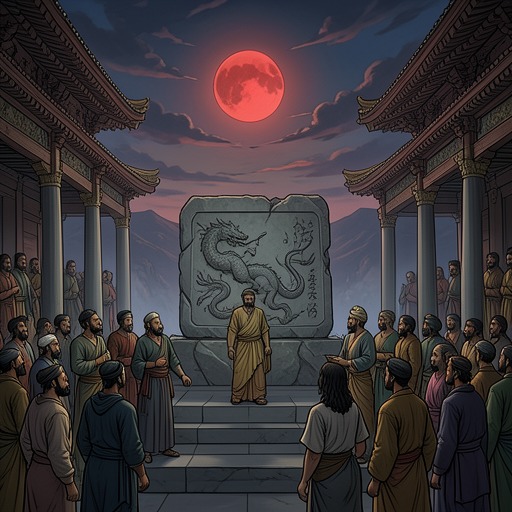
The case for abdication is framed as the natural end of a dynasty: what rises must fall, and every ruling house eventually reaches its limit. The emperor then presents the transfer as an act modeled on the ancient precedent of Yao, who did not favor his own son. Before a large assembly of officials and soldiers, he hands over the jade seal of authority. Cao Pi accepts it and begins his reign as emperor of Wei. The ceremony gives the change of regime a language of orderly succession, although the pressure surrounding the emperor’s decision makes the transfer more complicated than a simple, voluntary relinquishment.
The abdication does not settle the question of Han legitimacy. In Chengdu, reports of the new Wei dynasty and rumors that the former emperor has been killed unsettle Xuande. Kong Ming argues that Xuande should take the throne to continue the Han lineage, and he warns that refusal will drain the court of hope and leave Shu vulnerable to Wei and Wu. A proclamation in Xuande’s name casts his accession as the continuation of Han authority against Cao Cao’s and Cao Pi’s usurpations. The story thus ends the Han as a governing dynasty while keeping its name alive as the basis for a rival claim.
Political and Narrative Significance
The fall of the Han functions as the novel’s central pattern of dynastic rise and decline. The book connects the loss of imperial authority to greed, plotting officials, ambitious rulers, extravagance, and the failure of political judgment. It treats the long duration of Han rule not as protection against collapse, but as the reason the collapse is remembered as a profound rupture and an enduring warning about excessive ambition.
The dynasty’s legacy also structures later political reflection within the narrative. A petition to Sun Hao recalls that the Han fell and the Three Kingdoms arose from its ruins, then warns that the later lineages of Xuande and Cao Cao have themselves declined through abuse. The comparison turns the Han’s collapse into more than a past event: it is a measure of whether those who claim imperial inheritance can govern in a way that preserves the people and the state. The novel’s political drama repeatedly returns to the same unresolved tension—whether loyalty to the Han can restore a just order, or whether the language of restoration is itself drawn into the cycle of rival dynasties.